
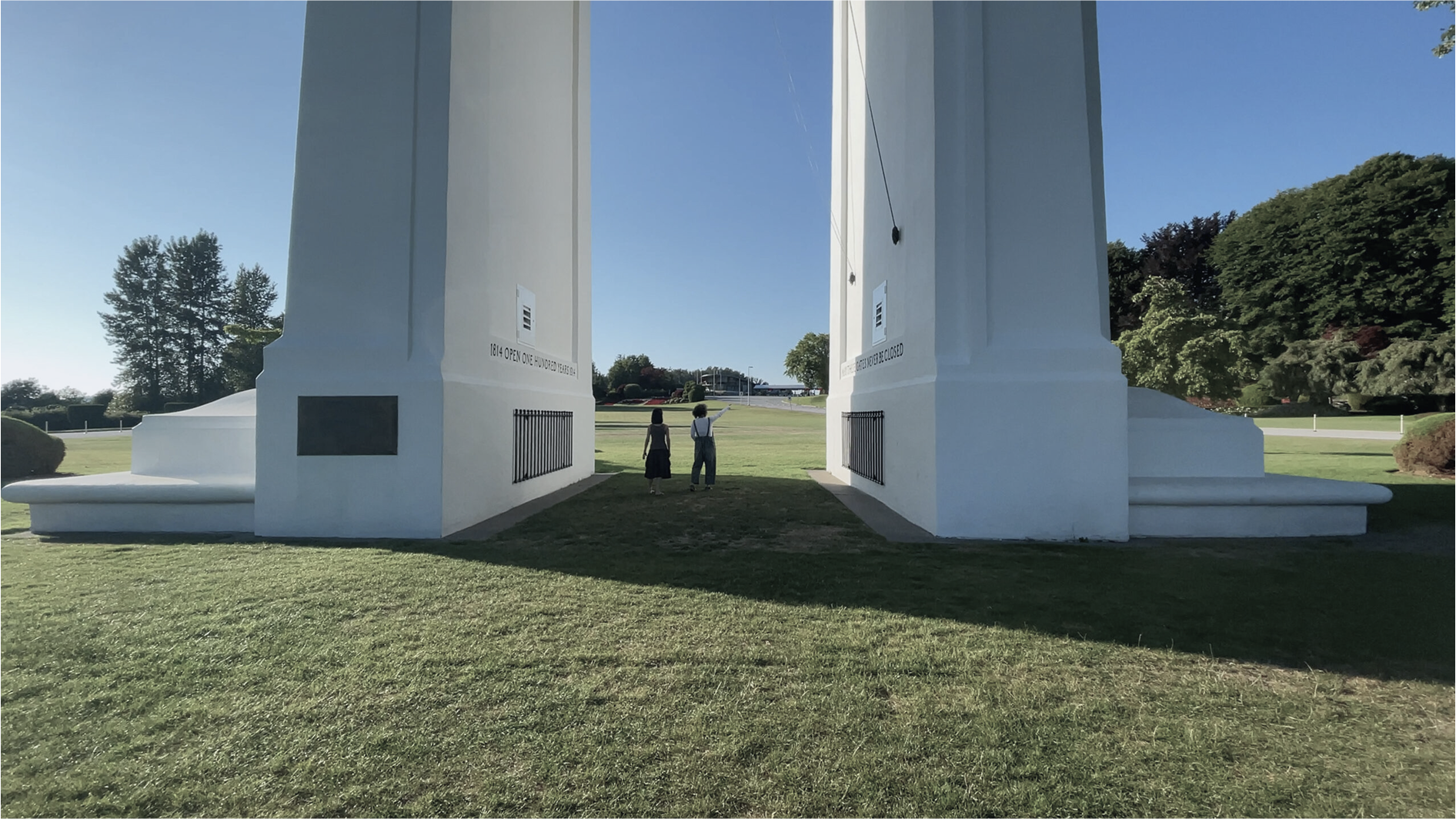
I live in British Columbia, Canada. My younger sister lives just across the border in Seattle, Washington State, United States. When the border abruptly closed in March 2020, I was separated from my only sibling in North America. A year into the pandemic, I discovered Peace Arch State Park, a rare place where families and loved ones, divided by the shutdown, could still meet face-to-face.
Our first reunion in the park was both eye-opening and deeply emotional.
Read more
Having grown up in China at a time when international travel was either forbidden or reserved for the privileged, the freedom to move across borders had always held special meaning for us. What began as a personal act of re-connection soon became a deeper reckoning with the very idea of borders.
At the Peace Arch State Park, I met not just Canadians and Americans, but people from around the world—couples, families, strangers—drawn together by urgency and longing, navigating the surreal choreography of a boundary newly made impenetrable. Before the pandemic, I had never truly questioned the concept of a border. But my life experience with a closed and authoritarian society had made me acutely aware of the tensions between individual liberty and state control. The park became a kind of paradise—both literal and metaphorical—offering a glimpse of how people might coexist more openly, more humanely.
As I kept filming, it became clear that the border was not simply a line on a map, but a psychological and political fiction with real, often absurd, consequences. The park transformed into a liminal space—part sanctuary, part stage—where contradictions of sovereignty, identity, and belonging played out in full view.
This film emerged from that space. It documents not only what I saw, but what the border revealed: the human improvisations, the collisions of intimacy and bureaucracy, and the quiet acts of resistance found in care, patience, and presence.
The recent resurgence of border anxieties between Canada and the United States doesn’t surprise me. That fleeting, fragile moment of openness at the Peace Arch State Park already felt like a fever dream—a brief suspension of geopolitical logic in the delirium of a global crisis.
Rather than assert a political stance, the film attempts something quieter but no less urgent: to listen. To let the border speak through those who crossed it, waited beside it, mourned beneath its shadow. This is not just a time capsule of an extraordinary moment—it is a meditation on the borders we live with, the ones we inherit, and the ones that are only becoming more entrenched.
About the Director

As a migrant navigating multiple cultures, Ying is drawn to stories that probe the complexities of humanity and question accepted narratives.
Ying was a writer and photographer in China before moving to Canada 25 years ago, initially as an international student and later becoming a landed immigrant. Her journey into filmmaking was deeply personal: when her younger sister developed a mental illness after immigrating to North America, Ying was compelled to tell their story. This led to her debut feature film, Sisters, which she directed as a self-taught filmmaker.
From 2007 to 2019, she completed her second film, The World is Bright, a feature-length documentary addressing immigration and mental health. The film received critical acclaim, winning the Sea to Sky Award at the Vancouver International Film Festival in 2019 and the Emerging Canadian Filmmaker Award at Hot Docs Canadian International Documentary Festival in 2020, and was nominated for two Canadian Screen Awards in 2021. The Border (2025) is her latest feature, continuing her exploration of global borders, resilience, and human connection.